I used to think being a good math teacher meant explaining clearly, helping quickly, and stepping in when students struggled. I worked hard, cared deeply, and ran a smooth, rewarding classroom. Still, something was missing.
I wanted more for my students. I knew there were better, more student-powered and collaborative ways to teach; but, I struggled to implement them. What finally moved my teaching forward was an important shift: I learned how to get out of the way.
After twenty-four years teaching mostly fourth and sixth grade, I believed I was doing everything I could for my students. Like many, I worked long hours and gave my best every day. What I didn’t realize was that I was being too helpful. That changed when two colleagues recommended Peter Liljedahl’s Building Thinking Classrooms in Mathematics. The core idea of the book is straightforward: lessons should be designed so that students do the thinking rather than the teacher.
Building Thinking Classrooms (BTC) challenges educators to be deliberately less helpful. It asks us to stop rescuing students, over-explaining, and answering many student questions. In doing so, it pushes teachers to stop removing the “productive struggle” that leads to learning. Instead of traditional front-of-the-room instruction, BTC emphasizes problem solving, collaboration, and carefully timed teacher guidance. At first, this approach felt uncomfortable and risky. It also worked. Immediately.
Many math students become skilled at what Liljedahl calls “student-ing”: mimicking strategies without understanding them. But how often are they truly problem solving and doing their own thinking? Liljedahl explains, “Mimicking tends to create short-term success without the long-term learning that allows students to make connections with other topics in the same and subsequent grades” (p.30).
Reading passages like this forced me to reflect on my own practice. I realized my instinct to help often encouraged mimicking rather than thinking. I decided to try BTC in my classroom.
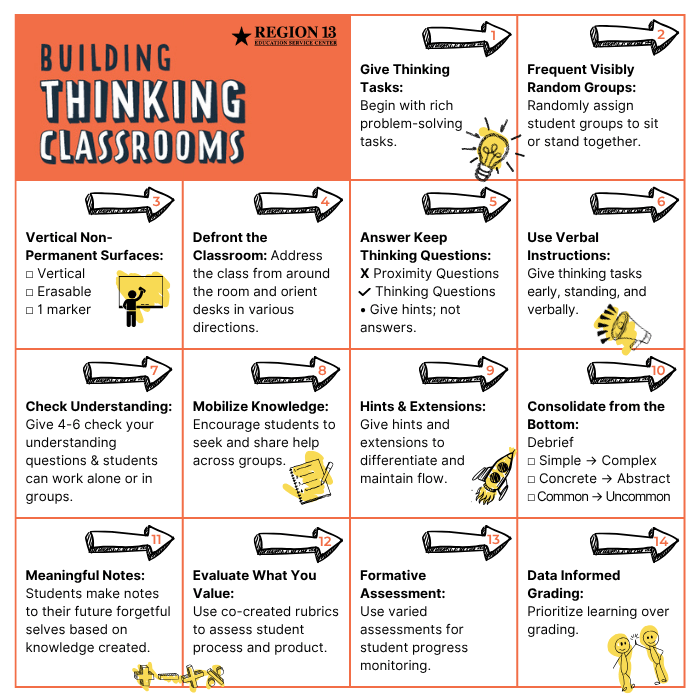
Two winters ago, I read one chapter each weekend and experimented with the ideas the following week. Not all fourteen BTC practices fit my style or setting, but many did. Here’s what I did:
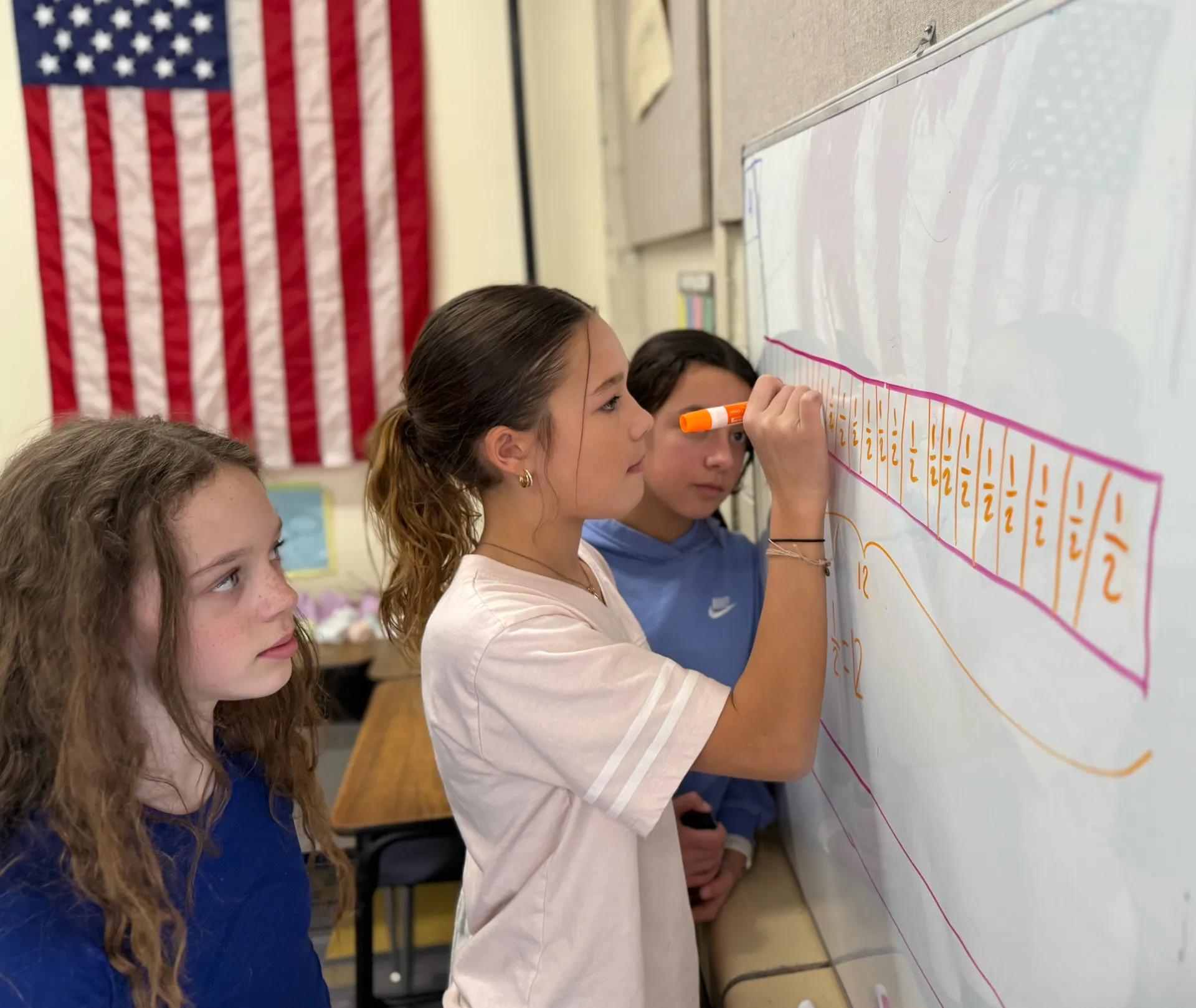
1 - I reorganized my classroom to include multiple vertical whiteboards and grouped desks into teams of three. Students are randomly assigned teams each day by drawing a playing card, which removes social pressure and keeps collaboration fresh.
2 - I began selecting fewer but deeper problems, mostly from our Illustrative Mathematics curriculum. Importantly, students are often problem solving to discover and practice skills that I then spotlight – rather than me teaching them skills so they can problem solve. Lessons are designed to encourage deep mathematical thinking, teamwork, and resilience by giving students time to grapple with complex, open-ended tasks instead of immediately seeking the “right” answer.
3 - I also intentionally limit direct answers to student questions. Answering most questions stops thinking. BTC gave me the permission I needed to step back. Sometimes the recommendation is simply to smile and walk away, then later explain why. This can be frustrating for students at first; but once they understand the purpose (more thinking!), they accept it. It allows for productive struggle—the learning “sweet spot,” where students are challenged just beyond their current ability without being overwhelmed. As Liljedahl notes, “Rather than being the source of knowledge in the room, teachers were working to mobilize the knowledge already in the room” (p.137).
4 - Instruction is no longer anchored to the front of the room. Directions, discussions, and gallery walks happen throughout the space. Students spend more time standing, which research shows increases engagement, risk-taking, and collaboration. My classroom is also now messier, too! BTC research suggests that overly tidy spaces can inhibit risk taking.
5 - Students now spend far more time talking about math. Discussion is the secret sauce in BTC classrooms. As my colleague Michelle Clarner put it, “By having students talk with each other they are reinforcing their own knowledge and passing knowledge to each other—something that reaches much farther than just a teacher instructing students.”
6 - I also give directions verbally more often. BTC research shows that verbal directions produce deeper thinking sooner and generate fewer questions across grade levels and contexts (p.110).
7 - Even homework has changed. We now call it “Checking Your Understanding.” Students choose problems, complete them, and correct their work using answer keys. The goal is reflection and learning, not producing work for the teacher.
8 - BTC also reinforced the importance of collaboration among educators. Leaning on other teachers, coaches, and PLCs keeps the work sustainable. I’m especially grateful to Michelle Clarner, whose encouragement made this shift possible. Like our students, adults need support too.
Students responded quickly to these changes and continue to enjoy them. Discussions are lively. Engagement, always a strength in my classroom, is now deeper. On some days, lessons enter what Liljedahl describes as a “flow state,” where time passes differently and students are surprised when class ends.
Not every lesson looks like this, and I haven’t adopted all of BTC . I still catch myself at the front of the room explaining too much, especially when time is short. But there are now regular moments of genuine discovery, discussion, and shared effort. During those moments, my role is to observe, guide, and bring the class together to reflect—mostly in their words, with me standing off to the side.
Over the past two years, BTC and a related Math Empowered course have led me to expect more thinking from my students. Engagement, curiosity, and growth are notable. SAS scores are at all-time highs (fourth in New Hampshire last year). Most importantly, students feel successful—and we’re often having fun. It’s a positive cycle.
BTC is the most impactful professional book I’ve read. It helped me rediscover what I value most in the classroom. School should be about thinking, connection, and curiosity, not memorizing procedures while lacking understanding. Not short-term learning. Thinking comes first.
As Liljedahl writes, “Thinking is a necessary precursor to learning, and if students are not thinking, they are not learning” (p.5). Or, as our friend Albert Einstein likes to remind us, “Education is not the learning of facts, but the training of the mind to think.”